|
|
|
THE LOCATION OF THE RED SEA CROSSING AND MOUNT SINAI
Did the ancient Egyptians leave an account of the Red Sea (Yam Suf) crossing? Most people who have studied this would respond, “But the ancient Egyptians never monumentalized their defeats.” Yes, and today no one is expecting to find an ancient Egyptian inscription that says, “The God of the Hebrew slaves beat us up.” However, there is an Egyptian legend (not the el-Arish Shrine) that does more than just lend itself to the sea crossing by Israel. It is about a battle that the Egyptian “gods” fought, and in this particular battle, the “good god,” who represents Egypt loses, and the “bad god,” who represents the foreigners wins, and it takes place at the bottom of the sea! And what is of more interest is that this takes place right in front of the four place names of the Red Sea/Yam Suf crossing, as given in Exodus 14:2! (Pi-hahiroth, Migdol, Baal-zephon, and yam suf.) But because this Egyptian account was said to have happened in an unexpected location, it has been passed over.
What follows is an abbreviated account of our second and third "Quest Books", the footnotes are in the book.
What follows is an abbreviated account of our second and third "Quest Books", the footnotes are in the book.
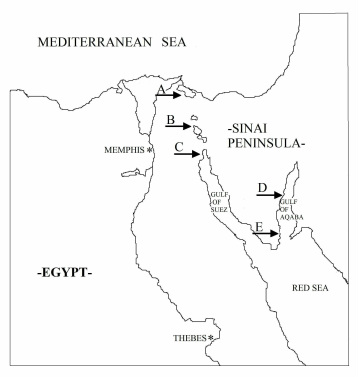
Is it true we will “never” find the stations of Exodus? Yes it is true, if we keep looking in the same places! Today there are more than a dozen locations for Mount Sinai and five main locations for the Red Sea crossing (see map to left and A-E locations). Some of these proposed sites are over a hundred miles apart, forcing the route and the encampments for the Exodus to different locations. Something must be fundamentally wrong to have such a divergence of opinions. There is. They started from the wrong place, the East Delta!
There are four ancient sources that have Moses or the children of Israel on the west side of the Nile.* “Now they took their journey by Letopolis” (west side of the Nile, Josephus, Antiq. II, 15, 1). Josephus even had this at the southern end of Letopolis, across from where Cairo would later be built, which would make it right in front of the Sphinx and Great Pyramid! (Please see Why Not the East Delta, "Section C", at the top of page.)
There are four ancient sources that have Moses or the children of Israel on the west side of the Nile.* “Now they took their journey by Letopolis” (west side of the Nile, Josephus, Antiq. II, 15, 1). Josephus even had this at the southern end of Letopolis, across from where Cairo would later be built, which would make it right in front of the Sphinx and Great Pyramid! (Please see Why Not the East Delta, "Section C", at the top of page.)
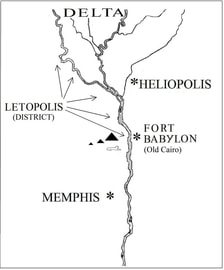
Josephus also said, “[T]hey set them [Israel] also to build pyramids...” (Antiq. II, 9:1) Few today believe what Josephus said about Israel building pyramids, but pyramids were built up to the time of Ahmose, of the 18th Dynasty, and all of the pyramids are on the west side of the Nile. Eusebius of Caesarea (263–339 AD) quoting Artapanus (200 BC), also has Israel leave from the west side of the Nile: (Praeparatio Evangelica, Book IX, Ch. XXVII, though he has Israel crossing the branches of the Delta, which would have been a disaster for their flocks and children). He also has the confrontation between Moses and Pharaoh taking place at Memphis, again on the west side of Nile (Book IX, Chapter 27:12-17), as does Philo (20 BC-50 AD,The Life of Moses, I, XX, 118) and John, Bishop of Nikiu (7th century AD, Chronicle, Ch. 30:2). *(Goshen was on both sides of the Nile Delta but the children of Israel would have been later moved to the west side after they became salves. The Bible tells us that the king of Egypt was afraid of them. “Come on, let us deal wisely with them; lest they multiply, and it come to pass, that, when there falleth out any war, they join also unto our enemies, and fight against us, and so get them up out of the land” (Exodus 1:10). Most of Egypt’s enemies were on the east side of the Delta, and if the Egyptians were afraid of Israel joining their enemies, it would make perfect sense to move them to the west side of the Nile and farther away from their Promised Land. See Why Not the East Delta (at top of page), "Section A & B".
... The Annual Flood of Egypt
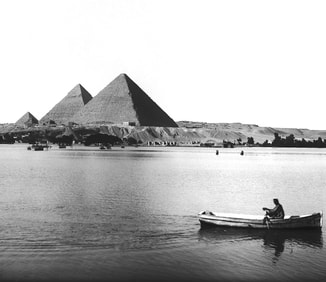
Before dams were built across the Nile, the Delta would flood every year for five months and become a sea. The villages in the Delta were built up on mounds, and looked like islands in a sea.
In the Egyptian Book of the Dead and the Pyramid Texts there is a place that is often mentioned called the “Field of Rushes” (papyrus). These myths were of their “gods” and their Egyptian heaven. The Egyptians associated heaven with things on earth that they were familiar with, and their heaven had both the Nile River and the Delta. At some point during the annual flood, the Egyptians referred to the “Field of Rushes” as a "Lake of Rushes". (Horus in the Pyramid Text, by Thomas George Allen, pp. 29 & 43) Modern Egyptians commonly call the Nile River El-Bahr, “The Sea”!
Before dams were built across the Nile, the Delta would flood every year for five months and become a sea. The villages in the Delta were built up on mounds, and looked like islands in a sea.
In the Egyptian Book of the Dead and the Pyramid Texts there is a place that is often mentioned called the “Field of Rushes” (papyrus). These myths were of their “gods” and their Egyptian heaven. The Egyptians associated heaven with things on earth that they were familiar with, and their heaven had both the Nile River and the Delta. At some point during the annual flood, the Egyptians referred to the “Field of Rushes” as a "Lake of Rushes". (Horus in the Pyramid Text, by Thomas George Allen, pp. 29 & 43) Modern Egyptians commonly call the Nile River El-Bahr, “The Sea”!
There has been much debate about the names “Red” Sea or “Reed” Sea. However, those who believe the sea Israel crossed was shallow water either do not know the Bible or simply do not believe it, as this body of water is called “the waters of the great deep” (Isaiah 51:10). “And the daughter of Pharaoh came down to wash herself at the river; and her maidens walked along by the river’s side; and when she saw the ark among the flags, she sent her maid to fetch it” (Exodus 2:5). The “flags” (reeds) in this verse is the word “suf” and is the same word translated “Red” from Red Sea in the Hebrew Scriptures. In the New Testament, there are two times where the sea Israel crossed is called the “Red” Sea in the Greek (Acts 7:35 and Hebrews 11:29), and this cannot be translated “reed” as in the Hebrew Yam Suph. Some believe the New Testament was following the lead of the Septuagint, also written in Greek, and which gave “Red Sea” for the Hebrew Yam Suph, but “All scripture is given by inspiration of God…” (II Timothy 3:16), not inspiration of the Septuagint. To say that because it was called a reed sea it therefore must be shallow water is like saying the Red Sea must be red, but it is blue like any other sea. Names are given for different reasons and names change. It is also possible to have more than one name for a location. The Sea of Galilee (Matthew 4:18) is also called the “Sea of Tiberias” (John 16:1), also “lake of Gennesaret” (Luke 5:1), and in the Hebrew Scriptures the “sea of Chinnereth” (Numbers 34:11). And so in the Hebrew Scriptures the sea Israel crossed is called the Yam Suf (sea of reeds) and 1,500 years later in the Greek New Testament it is called the Red Sea.
The border of Egypt. When referring to countries or seas mentioned in the Bible, remember that the boundary lines on today’s maps are not the same as in the days of Moses. When you look at a map and view the Red Sea, Egypt, Arabia, or Ethiopia, their locations are where they are today.
Some of the modern paintings of Christ are not those of a first-century Jew. Christ was a Jew by His mother, not the long, blond-haired, blue-eyed Anglo-Saxon that some have imagined. If the reader is not open to looking at God’s Word and the ancient Jewish sources (that place things in different locations), then some things will be forced and he will be looking in the wrong places. I believe the biggest hindrance to accepting this route, and therefore the Red Sea crossing along with the location of Mount Sinai, will not be because of a lack of evidence, but fighting the traditional “Anglo-Saxon” diagram some have imagined was the route of the Exodus.
The sea Israel crossed. My purpose here is to show where these ancient writers would place these names not to agree with their theology, for in some cases I strongly disagree. And even if one does not accept where these ancient texts place these locations, it cannot be denied that those who wrote them believe their accounts, and they have the Nile going into the sea known in the Hebrew as the Yam Suph, given as “Red Sea” in the English.
Legends of the Jews, when speaking of the ark of baby Moses that Miriam put in the Nile, said it was the Red Sea! “And then she abandoned the ark on the shores of the Red Sea” (vol. II, Moses Rescued from the Water). Babylonian Talmud (3rd century AD), also believed the placement of Moses’s ark was in the “Yam Suf” (Sotah 12a). The Qur’an also calls the crossing place the Red Sea; however, one Islam prophet explains that this was the Nile River! His name is Prophet Shu’ayb, and this is found in Hay Al Qulub vol. I, Stories of the prophets, section 13, “An Account of Musa (Moses) and Harun” (Aaron). The pertinent parts are: “Musa and the Israelites came to the bank of the river Nile. The water of river split and made a way to cross the river…and the last man of the Pharaoh entered into the river. Allah ordered the wind to move the water and the mountain of water fell on them.” The ancient Targums, Jonathan and Jerusalem (Aramaic translations of the Pentateuch), both connect the Nile to the Red Sea/Yam Suph: “and the Gihon had carried into the sea of Suph….” (Josephus and many other ancient Jewish and Christian writers have "Gihon" as the Nile River.) The same for the Dead Sea Scrolls, the Genesis Apocryphon (2nd–1st century BC): “I proceeded by the Red Sea until I reached the extension of the Reed Sea which goes out from the Red Sea, and then I turned southward, until I reached the Gihon River….” The person in this account was already on the “Red Sea” and goes to the “extension” of it, which he calls the “Reed Sea,” and then to the Nile, or “Gihon.” He is telling us that in his day the Red Sea was....(see page 113 of EXODUS: The Route, Sea Crossing, God's Mountain)
The Exodus of Israel was about three months before the annual flood. The sea that Israel crossed was the result of an early flood of the Delta from the seventh plague, “[T]he hail, very grievous, such as there was none like it in all the land of Egypt since it became a nation.” (Exodus 9:24) Not only was this plague “very grievous”, but the worst that had ever hit Egypt, and it was in “all” the land. “[A]ll the land” of Egypt included from the city of Syene (Ezekiel 29:10), 600 miles south of Memphis. This seventh plague was more than hail; it also rained. “And Moses went out of the city from Pharaoh, and spread abroad his hands unto the LORD: and the thunders and hail ceased, and the rain was not poured upon the earth. And when Pharaoh saw that the rain and the hail and the thunders were ceased....” (Exodus 9:33-34)
The border of Egypt. When referring to countries or seas mentioned in the Bible, remember that the boundary lines on today’s maps are not the same as in the days of Moses. When you look at a map and view the Red Sea, Egypt, Arabia, or Ethiopia, their locations are where they are today.
Some of the modern paintings of Christ are not those of a first-century Jew. Christ was a Jew by His mother, not the long, blond-haired, blue-eyed Anglo-Saxon that some have imagined. If the reader is not open to looking at God’s Word and the ancient Jewish sources (that place things in different locations), then some things will be forced and he will be looking in the wrong places. I believe the biggest hindrance to accepting this route, and therefore the Red Sea crossing along with the location of Mount Sinai, will not be because of a lack of evidence, but fighting the traditional “Anglo-Saxon” diagram some have imagined was the route of the Exodus.
The sea Israel crossed. My purpose here is to show where these ancient writers would place these names not to agree with their theology, for in some cases I strongly disagree. And even if one does not accept where these ancient texts place these locations, it cannot be denied that those who wrote them believe their accounts, and they have the Nile going into the sea known in the Hebrew as the Yam Suph, given as “Red Sea” in the English.
Legends of the Jews, when speaking of the ark of baby Moses that Miriam put in the Nile, said it was the Red Sea! “And then she abandoned the ark on the shores of the Red Sea” (vol. II, Moses Rescued from the Water). Babylonian Talmud (3rd century AD), also believed the placement of Moses’s ark was in the “Yam Suf” (Sotah 12a). The Qur’an also calls the crossing place the Red Sea; however, one Islam prophet explains that this was the Nile River! His name is Prophet Shu’ayb, and this is found in Hay Al Qulub vol. I, Stories of the prophets, section 13, “An Account of Musa (Moses) and Harun” (Aaron). The pertinent parts are: “Musa and the Israelites came to the bank of the river Nile. The water of river split and made a way to cross the river…and the last man of the Pharaoh entered into the river. Allah ordered the wind to move the water and the mountain of water fell on them.” The ancient Targums, Jonathan and Jerusalem (Aramaic translations of the Pentateuch), both connect the Nile to the Red Sea/Yam Suph: “and the Gihon had carried into the sea of Suph….” (Josephus and many other ancient Jewish and Christian writers have "Gihon" as the Nile River.) The same for the Dead Sea Scrolls, the Genesis Apocryphon (2nd–1st century BC): “I proceeded by the Red Sea until I reached the extension of the Reed Sea which goes out from the Red Sea, and then I turned southward, until I reached the Gihon River….” The person in this account was already on the “Red Sea” and goes to the “extension” of it, which he calls the “Reed Sea,” and then to the Nile, or “Gihon.” He is telling us that in his day the Red Sea was....(see page 113 of EXODUS: The Route, Sea Crossing, God's Mountain)
The Exodus of Israel was about three months before the annual flood. The sea that Israel crossed was the result of an early flood of the Delta from the seventh plague, “[T]he hail, very grievous, such as there was none like it in all the land of Egypt since it became a nation.” (Exodus 9:24) Not only was this plague “very grievous”, but the worst that had ever hit Egypt, and it was in “all” the land. “[A]ll the land” of Egypt included from the city of Syene (Ezekiel 29:10), 600 miles south of Memphis. This seventh plague was more than hail; it also rained. “And Moses went out of the city from Pharaoh, and spread abroad his hands unto the LORD: and the thunders and hail ceased, and the rain was not poured upon the earth. And when Pharaoh saw that the rain and the hail and the thunders were ceased....” (Exodus 9:33-34)
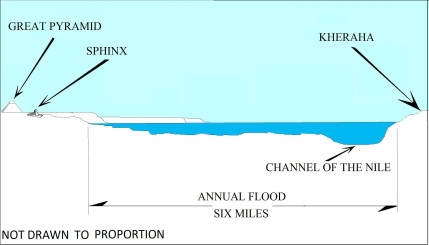
It takes ten days for the flood-waters from Syene to reach the Delta; it would then take several more days for the Nile Valley, which also floods (two miles or more on both sides of the Nile), to drain back into the Nile and into the Delta. All this time ancient Lake Moeris, which would have also been flooded, and normally relieved the flood-waters of the Nile, would instead be dumping water into the Nile, making the flood worse. Ussher's chronology has the seventh plague happening on the 5th of Abid; the Israelites leave on the 15th of the same month.
Numbers 33:7–8 says, “And they removed from Etham, and turned again unto Pi-hahiroth, which is before Baal-zephon: and they pitched before Migdol. And they departed from before Pi-hahiroth, and passed through the midst of the sea….” Israel went into the sea “before” or in front of Pi-hahiroth, so the sea was between Israel and Pi-hahiroth. In order for Israel to have entered the sea in front of Pi-hahiroth, Pi-hahiroth must have been on the other side of the sea from Israel. And Israel was said to have been “between” Migdol (The Great Pyramid) and the sea. Jewish legends that follow will show that Migdol and Baal-zephon were on the same side of the sea as Israel and also in back of Israel.
As to Migdol being the Great Pyramid, its location, as well as the location of each of the other sites, would fit with the Bible and Jewish traditions. The Legends of the Jews said, “Pharaoh is behind my flock Israel, in the south is Baal-zephon, in the north Midgol, and before us the sea lies spread out.” Only Pi-hahiroth was not mentioned in this legend because it was on the other side of the sea from Israel. Baal-zephon (Sphinx) was said to have been in the “south,” and Migdol (Great Pyramid) was said to have been in the “north.” The Great Pyramid is northeast of the Sphinx, but Legends of the Jews did not say that Migdol was north of Baal-zephon, only that it was north in relation to the camp of Israel. The positions of the Sphinx, Great Pyramid, the flooded Nile, and Kherahau all match up with the positions and points of compass for Migdol, Baal-zephon, the sea, and Pi-hahiroth.
As to Migdol being the Great Pyramid, its location, as well as the location of each of the other sites, would fit with the Bible and Jewish traditions. The Legends of the Jews said, “Pharaoh is behind my flock Israel, in the south is Baal-zephon, in the north Midgol, and before us the sea lies spread out.” Only Pi-hahiroth was not mentioned in this legend because it was on the other side of the sea from Israel. Baal-zephon (Sphinx) was said to have been in the “south,” and Migdol (Great Pyramid) was said to have been in the “north.” The Great Pyramid is northeast of the Sphinx, but Legends of the Jews did not say that Migdol was north of Baal-zephon, only that it was north in relation to the camp of Israel. The positions of the Sphinx, Great Pyramid, the flooded Nile, and Kherahau all match up with the positions and points of compass for Migdol, Baal-zephon, the sea, and Pi-hahiroth.
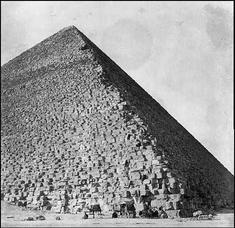
Migdol. This name is found seven times in the Bible and Strong’s #4024 says “Migdol for tower.” It is translated “tower” three times in the Bible (but never translated fort); the other four times it is not translated and simply given as “Migdol,” as it is found in the Exodus account (Exodus 14:2 and Numbers 33:7). The ancient Egyptian name for a pyramid was Mir; it was the Greeks who first started calling them pyramids, hundreds of years after the time of the Exodus. So the Hebrew Bible is not going to use the Greek name to describe them. For the Jews, it was Migdol, a tower; they were simply calling it by what it looked like to them, as we would say the Eiffel Tower. Ezekiel, a Jewish poet (2nd century BC), called the pyramids “towers.” As did Pliny the Elder (Roman author, 1st century AD), who, when talking about the pyramids of Egypt, said, on the “Libyan side, are the towers known as the Pyramids.” (Again, footnotes are in the book.)
|
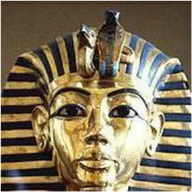
Why did the Jews use the Canaanite deity of Baal-zephon to identify with the Sphinx and not one of the other gods of the Canaanites? It is not sure what name the Egyptians originally called the Sphinx, but by 1450 BC, if not before, it had become associated with the Egyptian god Horus, and the Sphinx was called “Horus of the Horizon.” Remember, the name Baal-zephon means “lord of the north.” Pharaohs who ruled the two lands (northern and southern Egypt) could show this by wearing the double crown, which had emblems of the north and south. Or they could wear both the vulture (symbol of the south) and the cobra (symbol of the north) on their headdress, as is seen on King Tutankhamun’s grave mask.
|
|
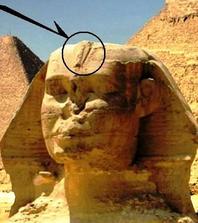
The Uraeus, or cobra, was the symbol of northern Egypt. On the upper forehead of the Sphinx is clearly seen the Uraeus, or cobra, and it is made from the stone of the Sphinx itself. The tail of the cobra is missing today; perhaps it once sat on the head of the Sphinx, but the outline of the cobra, though defaced, is still seen on the front of the Sphinx. The head part of this cobra has been broken off, as have the nose and false beard. However, the two-foot limestone piece with the eyes and mouth of the Sphinx’s cobra was found between the paws of the Sphinx and is now in the British Museum (#1204). It is has the dimensions of: length, 59 centimeters; width, 33 centimeters; height, 30 centimeters. Since the Sphinx only had the cobra (Uraeus) as a permanent part of it, and therefore was a symbol of northern Egypt, it was a clear sign to all that the Great Sphinx was ruling the north, and to the Hebrews, this was Baal-zephon, “Lord of the north”!
Did the ancient Egyptians leave an account of the Red Sea (Yam Suf) crossing?
There is an Egyptian legend about a battle between two of their gods, and in this particular battle, the “good god,” who represents Egypt, loses, and the “bad god,” who represents the foreigners, wins, and it takes place at the bottom of the sea! This was said to have happened in the Nile, and what is of more interest is that this takes place right in front of the four place names of Exodus 14:2, as given in our book EXODUS! But it has been passed over because today people are looking to the Isthmus or the Gulf of Suez, or the Gulf of Aqaba, not the flooded Nile, for the sea crossing. “If you start in the wrong place, you will look, search and go to the….”
The Quest for the Red Sea Crossing
The second book in our Quest Series
(Should be read before The Quest for Mount Sinai.)
Both paperback and kindle.https://www.amazon.com/dp/1982966114
The book can be read for FREE! https://www.truechristianshortstoriesfreebygmmatheny.com/the-quest-for-the-red-sea-crossing.html
See video (8 min) below about the sea crossing and the four place names of Exodus 14:2.
There is an Egyptian legend about a battle between two of their gods, and in this particular battle, the “good god,” who represents Egypt, loses, and the “bad god,” who represents the foreigners, wins, and it takes place at the bottom of the sea! This was said to have happened in the Nile, and what is of more interest is that this takes place right in front of the four place names of Exodus 14:2, as given in our book EXODUS! But it has been passed over because today people are looking to the Isthmus or the Gulf of Suez, or the Gulf of Aqaba, not the flooded Nile, for the sea crossing. “If you start in the wrong place, you will look, search and go to the….”
The Quest for the Red Sea Crossing
The second book in our Quest Series
(Should be read before The Quest for Mount Sinai.)
Both paperback and kindle.https://www.amazon.com/dp/1982966114
The book can be read for FREE! https://www.truechristianshortstoriesfreebygmmatheny.com/the-quest-for-the-red-sea-crossing.html
See video (8 min) below about the sea crossing and the four place names of Exodus 14:2.
When Jesus Christ died on the cross, there were two other men who died that day. And both had broken the 8th commandment, “Thou shalt not steal”. Jesus took one to Heaven, but not the other. What made the difference? They both believed Christ existed, for they both talked to him, but only one of them trusted Christ for salvation. This was the one who recognized he was a sinner, and deserved the punishment of his crime, for he said, “we receive the due reward of our deeds….” He did not make excuses for his sins but looked to Jesus, the only one who could forgive him, and put his faith in Christ, and asked the Lord to save him. “And he said unto Jesus, Lord, remember me when thou comest into thy kingdom. And Jesus said unto him, Verily I say unto thee, To day shalt thou be with me in paradise.” (Luke 23:42-43) Say to Jesus, “Lord remember me, I want to come into your kingdom when I die. I ask you to save my soul, and please forgive all my sins. I want you to live your life in me.” “For whosoever shall call upon the name of the Lord shall be saved.” (Romans 10:13).
The Quest for Mount Sinai
The third book in our Quest Series.
A pharaoh of Egypt went to Mount Sinai and engraved his named there! In December 2013, two years after EXODUS was first published, an inscription made by a pharaoh of Egypt was found at Mount Gharib, which I have proposed as Mount Sinai. And more than a hundred years ago, a hieroglyphic inscription was found in the East Nile Delta, also made by a king of Egypt, describing an expedition to a location the scholars have hotly debated. But the location is now confirmed, for the same king made both inscriptions, and he found something there that only Israel could have left.
Both Paperback and kindle. https://www.amazon.com/dp/1983006815
https://www.amazon.com/dp/B07DBF8TYV
The book can be read for FREE! https://www.truechristianshortstoriesfreebygmmatheny.com/the-quest-for-mount-sinai.html
=================================================================================================
The third book in our Quest Series.
A pharaoh of Egypt went to Mount Sinai and engraved his named there! In December 2013, two years after EXODUS was first published, an inscription made by a pharaoh of Egypt was found at Mount Gharib, which I have proposed as Mount Sinai. And more than a hundred years ago, a hieroglyphic inscription was found in the East Nile Delta, also made by a king of Egypt, describing an expedition to a location the scholars have hotly debated. But the location is now confirmed, for the same king made both inscriptions, and he found something there that only Israel could have left.
Both Paperback and kindle. https://www.amazon.com/dp/1983006815
https://www.amazon.com/dp/B07DBF8TYV
The book can be read for FREE! https://www.truechristianshortstoriesfreebygmmatheny.com/the-quest-for-mount-sinai.html
=================================================================================================
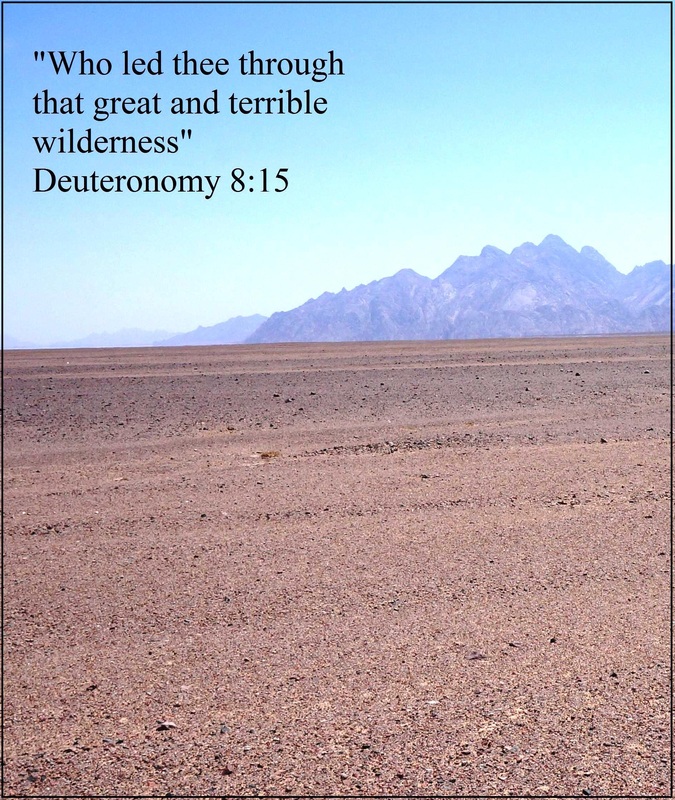
Thank you Israel for preserving the first and second commandment (Deuteronomy 5:7–10), without which the world would still be worshiping a multitude of gods and their idols. To Israel, through a prophet, God proclaims a blessing. “Blessed is he that blesseth thee, and cursed is he that curseth thee” Amen! (Numbers 24:5–9).
A pharaoh of Egypt went to Mount Sinai
and engraved his named there!
In December 2013 an inscription made by a King of Egypt was found at Mount Gharib, which I have proposed as Mount Sinai. And in 1882 a hieroglyphic inscription was found in the East Nile Delta, also made by a king of Egypt, describing an expedition to a location the scholars have hotly debated. But the location is now confirmed, for the same king made both inscriptions, and he found something there that only Israel could have left. More about this further on.
A pharaoh of Egypt went to Mount Sinai
and engraved his named there!
In December 2013 an inscription made by a King of Egypt was found at Mount Gharib, which I have proposed as Mount Sinai. And in 1882 a hieroglyphic inscription was found in the East Nile Delta, also made by a king of Egypt, describing an expedition to a location the scholars have hotly debated. But the location is now confirmed, for the same king made both inscriptions, and he found something there that only Israel could have left. More about this further on.
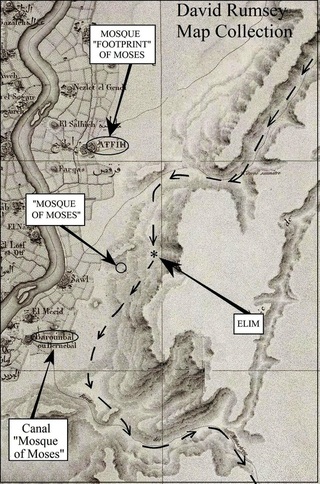
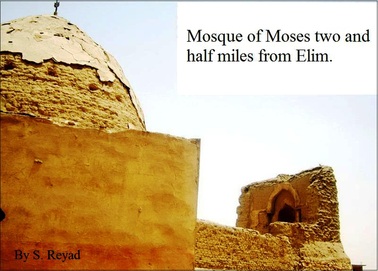
Three Muslim sites in a row
bear witness to Moses being on this route.
There is no other Mosque of Moses in Egypt.
Traditions. Besides archaeology and history, there are traditions to consider. In truth, traditions are not the most trustworthy sources and may have been created simply to help out the local tourism industry. I once heard a certain city in Europe claimed to have “all seventeen graves” of the original twelve apostles! So though I was not looking for any signs that said “Moses slept here,” still, traditions are expected to have been passed down if one has the right route for the Exodus, and there are more traditions for this route than all the others put together!
bear witness to Moses being on this route.
There is no other Mosque of Moses in Egypt.
Traditions. Besides archaeology and history, there are traditions to consider. In truth, traditions are not the most trustworthy sources and may have been created simply to help out the local tourism industry. I once heard a certain city in Europe claimed to have “all seventeen graves” of the original twelve apostles! So though I was not looking for any signs that said “Moses slept here,” still, traditions are expected to have been passed down if one has the right route for the Exodus, and there are more traditions for this route than all the others put together!
ELIM “[F]ountains, which were in number twelve: they were rather a few moist places than springs, which not breaking out of the ground, nor running over, could not sufficiently water the trees. And when they dug into the sand….they found it to be useless, on account of its mud.” (Josephus. Antiquities III, 1, 3, & Legends of the Jews, The Awful Desert). The Bible said Elim had twelve wells, the Bedouins said there were, “Twelve, plus one or minus one.” The site is over a mile square, with many of them being what they called “wet sand”, like Josephus who called them “moist places…”
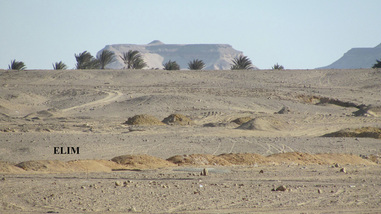
Please see "Maps of Elim" at the top of page. If
you use the zoom in feature you can count over 70 palm trees at this site,
and 12 groups of palm trees, where water comes
up through the ground. Sir Wilkinson had said that though one can find
small trees out on the desert with no apparent source of water, it was
not so when speaking about the palm tree. “I
never saw or heard of any palms but near water; though in many vallies
of the primitive mountains there are innumerable seyale, tamarisk, and
other trees, the palm we never found but at the watering-places
themselves.” (Sir Wilkinson, British Egyptologist)
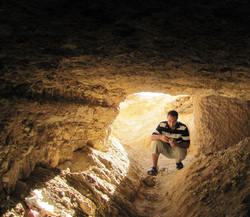
“And
they removed from
the desert of Sinai, and pitched at Kibrothhattaavah” “("graves of lust” , Strong’s #6914). “And he called the name of
that place Kibroth-hattaavah: because there they buried the
people that lusted” (Numbers 11:34). “Therefore
the LORD heard this, and was wroth: so a fire was kindled
against Jacob" (Psalms
78:15–31, God cremated them!). This is the only time
in their forty years of wandering that the Bible mentions the Israelites
burying their dead (except for Moses, Aaron and Miriam, because of who they
were), no other mass graves are mentioned. Those
who were buried at the “Graves of Lust” had been burned to death.
Sir John Gardner Wilkinson, who explored them in 1823. “We met with nothing interesting along this flat shore till we arrived at the low hills of Wady Girfe...a small knoll containing eighteen excavated chambers, besides, perhaps, many others, the entrances of which are no longer visible. We went into those where the doors were the least obstructed by the sand...We sought in vain for inscriptions or hieroglyphics; our curiosity was only rewarded by finding the scattered fragments of vases, bitumen, charcoal, and cloth. It is evident that the bodies were burnt, and the ashes, after the usual ceremony of bathing and wrapping them in these cloths, were probably deposited in the vases, of which innumerable broken remains are seen in every direction."
Sir John Gardner Wilkinson, who explored them in 1823. “We met with nothing interesting along this flat shore till we arrived at the low hills of Wady Girfe...a small knoll containing eighteen excavated chambers, besides, perhaps, many others, the entrances of which are no longer visible. We went into those where the doors were the least obstructed by the sand...We sought in vain for inscriptions or hieroglyphics; our curiosity was only rewarded by finding the scattered fragments of vases, bitumen, charcoal, and cloth. It is evident that the bodies were burnt, and the ashes, after the usual ceremony of bathing and wrapping them in these cloths, were probably deposited in the vases, of which innumerable broken remains are seen in every direction."
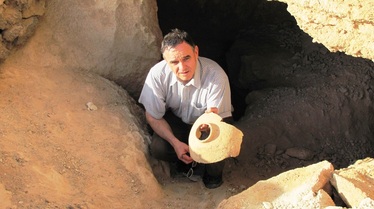
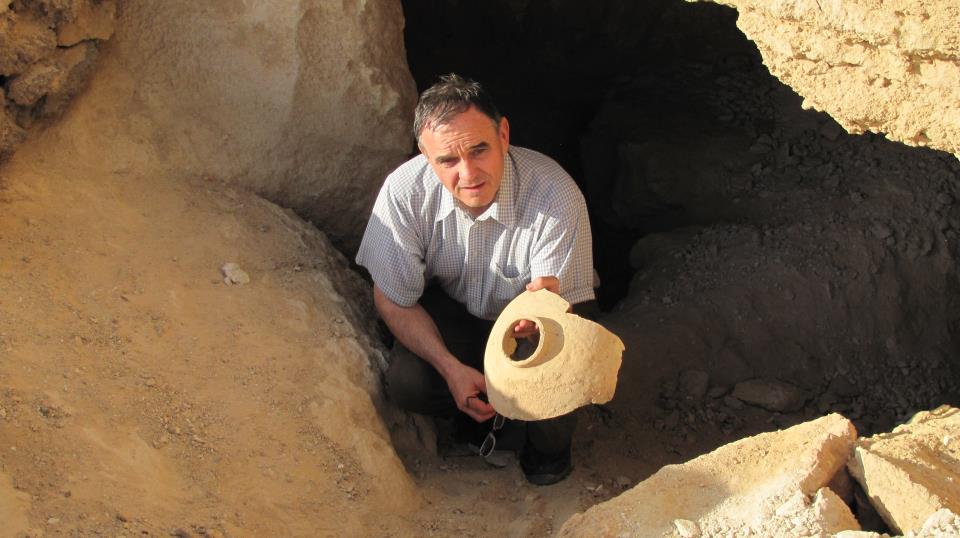
I had the pottery dated using thermoluminescence (TL) and accelerator
mass spectrometry (AMS). I had hoped AMS technicians might find some carbon
material, such as a twig imbedded in the clay of the pottery and thus establish
a radiocarbon date for that time period, but none was found. (AMS testing
January 2, 2013, Beta Analytic Inc., Miami, Florida.) Thermoluminescence
gives the approximate date by heating a sample with a laser. The
luminescence the pieces give off can then be measured to give the date
of its last firing (when it was made). There were three laboratories the pieces were sent too, and all three were told
the pieces were found in the Eastern Desert of Egypt.
The oldest date came from the laboratory in France which
gave 3,230 years old or 1230 BC, with plus or minus 310 years, or about 10
percent margin of error, between 920 BC and 1530 BC (December 16, 2010, Ciram,
Centre d’Innovation et de Recherche pour l’Analyse et le Marquage).
“And they departed from Kibroth-hattaavah, and encamped at Hazeroth” (Numbers 33:17).
“And they departed from Kibroth-hattaavah, and encamped at Hazeroth” (Numbers 33:17).
|
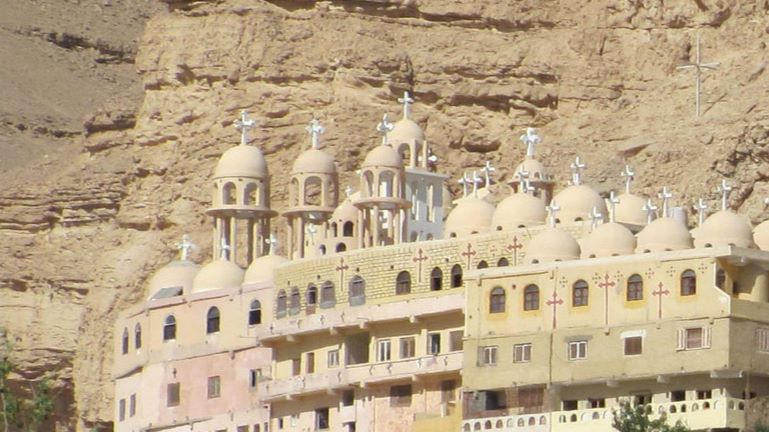
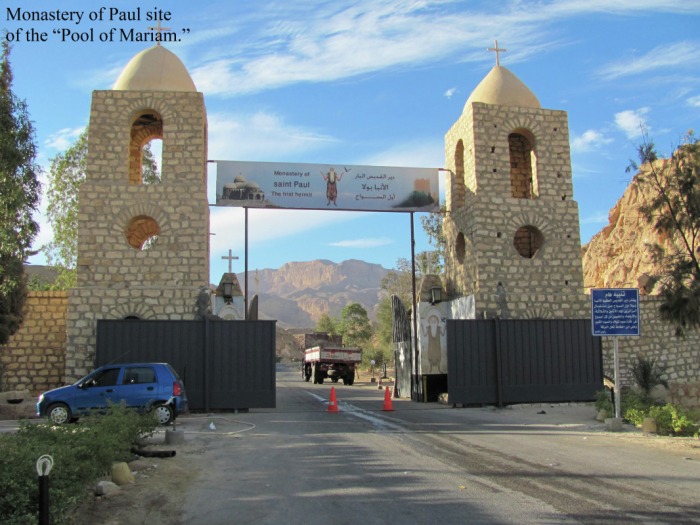
Monastery of Paul, less than ten miles
from the "catacombs" of Sir Wilkinson. At the Monastery of St. Paul, there is a tradition that says the sister of Moses washed in a pool there during the time of the Exodus, called the "pool of Miriam." It was at the encampment Hazeroth, which followed Kibroth-hattaavah (Numbers 33:17), where Miriam was struck with leprosy. It is of interest that this tradition from |
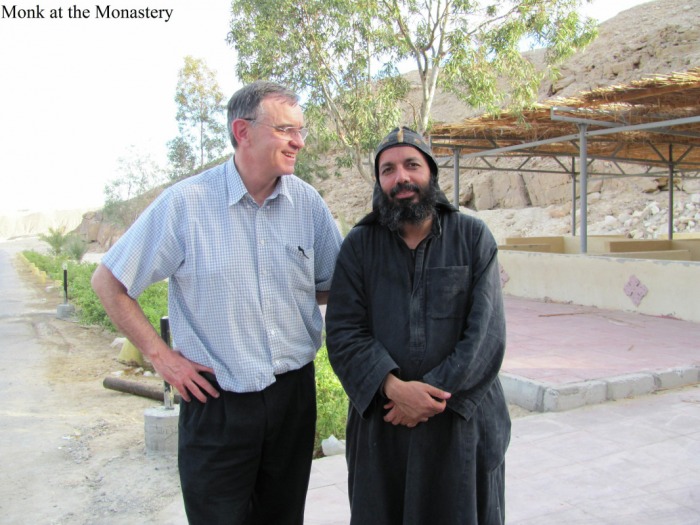
Author with monk from the Monastery of St. Paul
the Monastery of St. Paul (also from ancient Arab writers) makes no mention of anyone else in the camp of Israel doing this, not even Moses or Joshua or Aaron, but only Miriam, the one person who was struck with leprosy at Hazeroth (Numbers 12:15). And according to the Bible (Leviticus 14:9), she would have been required to wash both her clothes and herself in water (“Pool of Miriam”) before re-entering the camp. |
The location of Mount Sinai was
by the country of Troglodytes, near the land of Midian, and in
Arabia. The first one is given to us by Josephus (1st
century, Antiquities, II, 11:1–2, and
the other two come from the Bible, Exodus 2:15, Galatians 4:25).
Where was the country of Troglodytes? “Between Egypt and the Red Sea were nations of Arabians called Troglodyte…” (Sir Isaac Newton, 17th century, mathematician, astronomer, also Diodorus and Strabo, quotes in our book.) Josephus, when giving the account of Moses meeting the daughters of Jethro (the priest of Midian, Exodus 3:1), said, “These virgins, who took care of their father’s flocks, which sort of work it was customary and very familiar for women to do in the country of the Troglodytes….”
“And the sons of Midian; Ephah, and Epher, and Hanoch, and Abida, and Eldaah.” (Genesis 25:4). Please observe the difference in spelling when hundreds of years later Josephus, writing in the Greek language, quoted from this same passage, “The sons of Madiau were Ephas, and Ophren, and Anoch, and Ebidas, and Eldas. Now, for all these sons and grandsons, Abraham contrived to settle them in colonies; and they took possession of Trogodytes, and the country of Arabia the Happy, as far as it reaches to the Red Sea.” There are a few who have thought Josephus was saying that Troglodytes was in the country of “Arabia the Happy,” which is on the east side of the Red Sea. But he said that Abraham’s descendants through Keturah “took possession of Trogodytess, and the country of Arabia the Happy….” He is saying they became two countries: Troglodytes and Arabia the Happy.
From the Scriptures we see that the Midianites lived in different locations. Israel, during the Exodus, left the Midianites, who dwelled close by Mount Sinai (Exodus 3:1, 18:1–5), and some Midianites departed with Israel (Judges 1:16, Numbers 10:29–32). And on their way to the Promised Land, they met up with a group of Midianites who were allied with Moab against them (Numbers 22:3–7). In I Kings 11:17–18, some Edomites fled to Egypt, and we are told they “arose out of Midian,” then to Paran and then to Egypt. If one insists that Midian was only in Saudi Arabia, then these men from the land of Edom made a pointless trip, far out of their way, to go to Egypt.
Pliny (Roman author, 1st century) also said the Troglodytes lived on the west side of the Gulf of Suez and added that “Trogodytice, the old Midoen, some Midioen.” (Spelled Madian in the New Testament, Acts 7:29.) Josephus (1st century), writing in Greek, spells the name of Midian as “Madiau” (Antiquities, I, 15, 1); Pliny (1st century), writing in Latin, spells the name as Midoen or Midioen. And both say the Midianites lived among the Troglodytes.
Paul said that Mount Sinai was in Arabia (Galatians 4:25). The question is not where Saudi Arabia is, but where was Arabia? And the Arabians lived in different locations (II Chronicles 26:7), as “the Arabians, that were near the Ethiopians” (Chronicles 21:16. This would be the Eastern Desert). The classical writers said the ridge above the Nile, on the east, was “Arabia” (given above). I am not saying the name Arabia was confined only to the Eastern Desert of Egypt, but it was included in this area. And even today most maps name Egypt’s Eastern Desert the “Arabian Desert.” (The Eastern Desert of "Egypt" was not part of Egypt when the Bible was written.)
Question. “But wouldn’t Mount Sinai be in the Sinai Peninsula?” The classical writers called the Peninsula “Arabia.” Historically, there is no record of either the peninsula or a mountain in this area being called Sinai before the 3rd century after Christ.
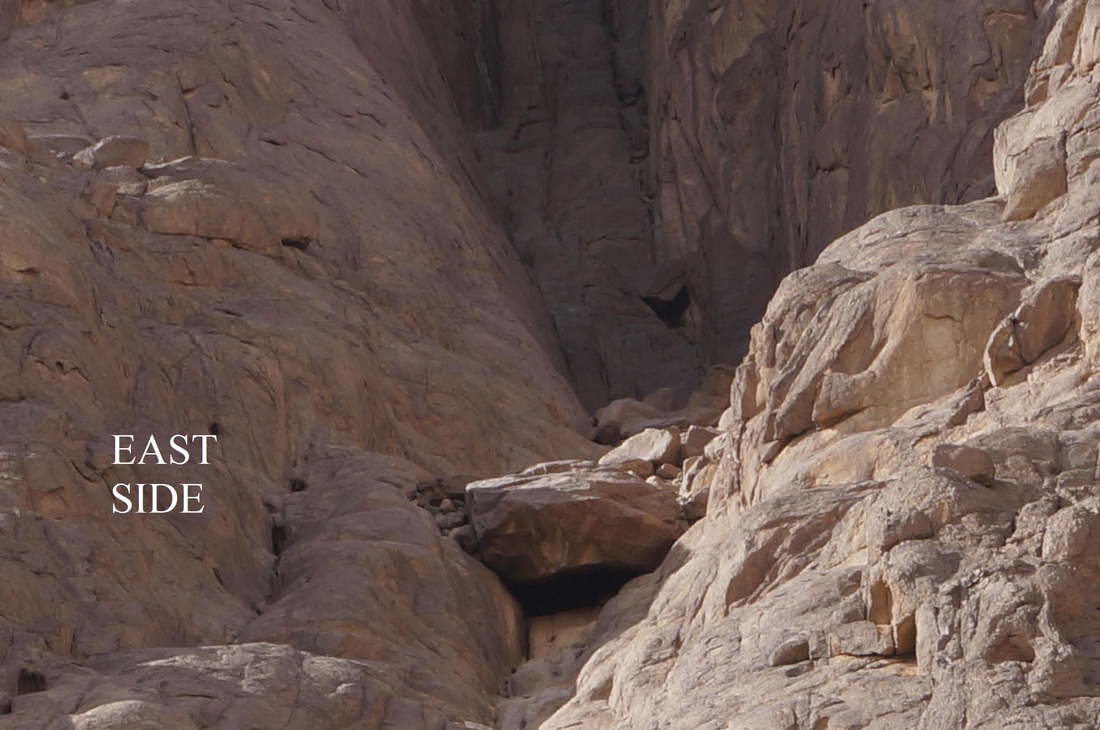
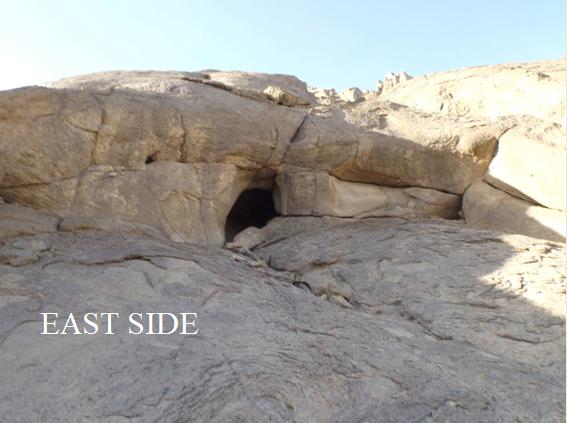
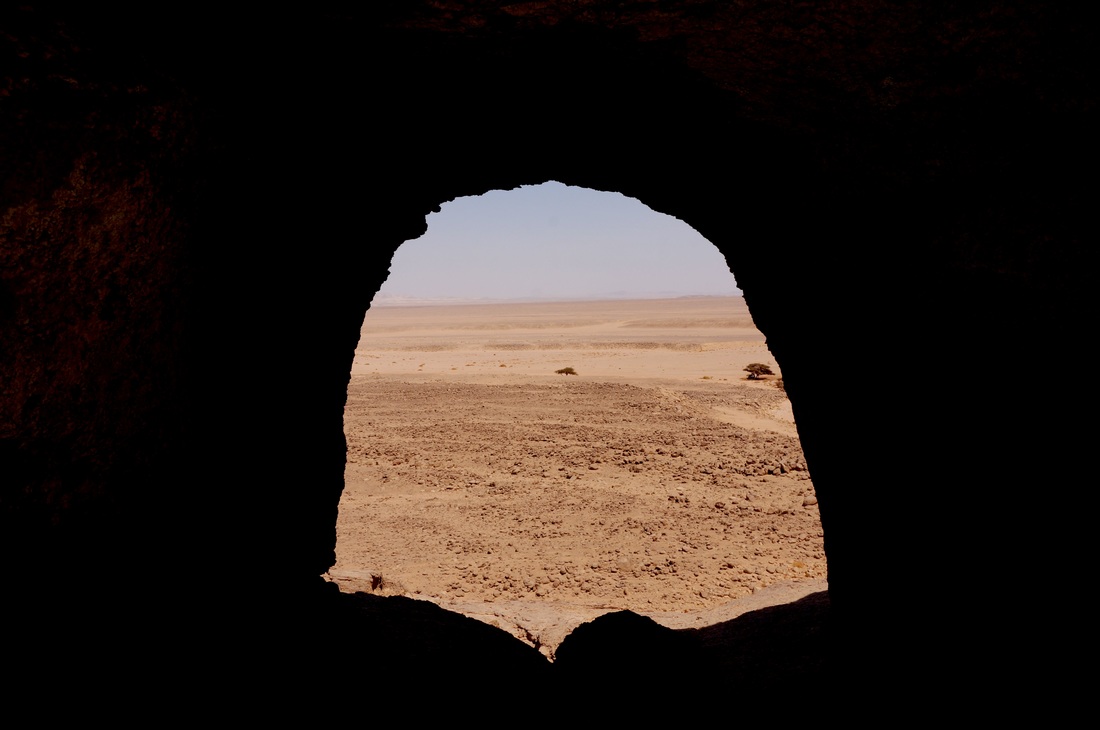
When Elijah came to Mount Sinai, he stayed in a cave, but God twice asked him, “What doest thou here, Elijah?” Then He sent Elijah back to serve Him by ministering to others and telling them what God had said.
Where was the country of Troglodytes? “Between Egypt and the Red Sea were nations of Arabians called Troglodyte…” (Sir Isaac Newton, 17th century, mathematician, astronomer, also Diodorus and Strabo, quotes in our book.) Josephus, when giving the account of Moses meeting the daughters of Jethro (the priest of Midian, Exodus 3:1), said, “These virgins, who took care of their father’s flocks, which sort of work it was customary and very familiar for women to do in the country of the Troglodytes….”
“And the sons of Midian; Ephah, and Epher, and Hanoch, and Abida, and Eldaah.” (Genesis 25:4). Please observe the difference in spelling when hundreds of years later Josephus, writing in the Greek language, quoted from this same passage, “The sons of Madiau were Ephas, and Ophren, and Anoch, and Ebidas, and Eldas. Now, for all these sons and grandsons, Abraham contrived to settle them in colonies; and they took possession of Trogodytes, and the country of Arabia the Happy, as far as it reaches to the Red Sea.” There are a few who have thought Josephus was saying that Troglodytes was in the country of “Arabia the Happy,” which is on the east side of the Red Sea. But he said that Abraham’s descendants through Keturah “took possession of Trogodytess, and the country of Arabia the Happy….” He is saying they became two countries: Troglodytes and Arabia the Happy.
From the Scriptures we see that the Midianites lived in different locations. Israel, during the Exodus, left the Midianites, who dwelled close by Mount Sinai (Exodus 3:1, 18:1–5), and some Midianites departed with Israel (Judges 1:16, Numbers 10:29–32). And on their way to the Promised Land, they met up with a group of Midianites who were allied with Moab against them (Numbers 22:3–7). In I Kings 11:17–18, some Edomites fled to Egypt, and we are told they “arose out of Midian,” then to Paran and then to Egypt. If one insists that Midian was only in Saudi Arabia, then these men from the land of Edom made a pointless trip, far out of their way, to go to Egypt.
Pliny (Roman author, 1st century) also said the Troglodytes lived on the west side of the Gulf of Suez and added that “Trogodytice, the old Midoen, some Midioen.” (Spelled Madian in the New Testament, Acts 7:29.) Josephus (1st century), writing in Greek, spells the name of Midian as “Madiau” (Antiquities, I, 15, 1); Pliny (1st century), writing in Latin, spells the name as Midoen or Midioen. And both say the Midianites lived among the Troglodytes.
Paul said that Mount Sinai was in Arabia (Galatians 4:25). The question is not where Saudi Arabia is, but where was Arabia? And the Arabians lived in different locations (II Chronicles 26:7), as “the Arabians, that were near the Ethiopians” (Chronicles 21:16. This would be the Eastern Desert). The classical writers said the ridge above the Nile, on the east, was “Arabia” (given above). I am not saying the name Arabia was confined only to the Eastern Desert of Egypt, but it was included in this area. And even today most maps name Egypt’s Eastern Desert the “Arabian Desert.” (The Eastern Desert of "Egypt" was not part of Egypt when the Bible was written.)
Question. “But wouldn’t Mount Sinai be in the Sinai Peninsula?” The classical writers called the Peninsula “Arabia.” Historically, there is no record of either the peninsula or a mountain in this area being called Sinai before the 3rd century after Christ.
When Elijah came to Mount Sinai, he stayed in a cave, but God twice asked him, “What doest thou here, Elijah?” Then He sent Elijah back to serve Him by ministering to others and telling them what God had said.

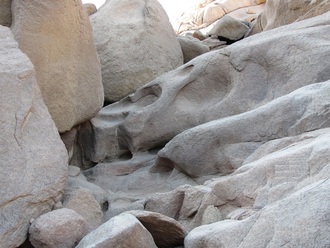 Water erosion marks in the granite gullies of Mount Gharib.
Should we find water erosion
marks from the rock that Moses struck at Horeb (Exodus
17:6)? I do not see how water erosion marks can be used as evidence
that one has the right spring of Moses. Water erosion marks can be found
all over the desert! In the Eastern Desert of Egypt it seldom rains, but
when it does it pours. These flash floods are what cause the
wadis in the desert and they are found around every mountain. Water erosion marks can also be found in the granite gullies of
Mount Gharib, as they could at any mountain in the area.
At the Gharib Mountain Range there is the “Fount of the Salve” (Hem-t-elabd, Wilkinson translation), and this may preserve the event described in Exodus, but to point to water erosion marks is not evidence. Nor is a picture of a large, split rock. Legends of the Jews (vol. III, Miriam’s Well) makes the rock out to be something small. The Bible does not tell us how large the rock was, but split rocks can be found anywhere!
At the Gharib Mountain Range there is the “Fount of the Salve” (Hem-t-elabd, Wilkinson translation), and this may preserve the event described in Exodus, but to point to water erosion marks is not evidence. Nor is a picture of a large, split rock. Legends of the Jews (vol. III, Miriam’s Well) makes the rock out to be something small. The Bible does not tell us how large the rock was, but split rocks can be found anywhere!
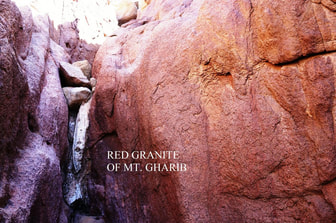
Would
it hurt your eyes to look at Mount Sinai? Sounds like a strange question, but Josephus
said of Mount Sinai, “indeed, it cannot
be looked at without pain of the eyes.” (Antiquities III, 5, 1. There is more about this in our book EXODUS
but I give here an abbreviated part.) The
classical writers talk of such a mountain. Diodorus (1st century BC)
said, “first of all we shall take the
right side, the coast of which is inhabited by tribes of the Trogodytes as far
inland as the desert. In the course of the journey, then, from the city of
Arsinoê along the right mainland, in many places numerous streams, which have a
bitter salty taste, drop from the cliffs into the sea. And after a man has
passed these waters, above a great plain there towers a mountain whose
colour is like ruddle and blinds the sight of any who gaze steadfastly upon it
for some time.” (Diodorus, History,
III, 39, 1). Strabo (1st century AD, Greek geographer) said, “As one sails from the City of Heroes along
the Troglodytic country, one comes to a city Philotera…Then to another city,
Arsinoê. Then to springs of hot water, salty and bitter, which flow down a high
rock and empty into the sea. Near by, in a plain, is a mountain which is
of a red colour like minium.” (Strabo, Geography, XVI, 4, 5). In
both accounts of Diodorus and Strabo, the mountain was said to be in a plain.
Mount Gharib sits in the middle of an eighty by fifteen-mile desert, and is by
far the most notable mountain in that whole area. Diodorus added that in this “great plain there towers a mountain” (the one that “blinds the sight”); this would definitely fit Mount Gharib. Both Diodorus and Strabo said it was as a bright rust-colored
mountain, “colour is like ruddle” (red
iron ore), and “a red colour like
minium” (red lead). However, most ancient geographers
do not mention this blinding rust-colored mountain. During the time I was at
Mount Gharib, including driving around it once, I only noticed this red color
one time, and it was not bright. But it depends on the angle of the sun and how
clear the sky is. When the sun shines directly on it the color will be grey and often there are sandstorms that cover the mountain in dust. In 1937, an archaeologist named G.W. Murray climbed Mount
Gharib and said, “All the massif…is
composed of a beautiful red
granite, which glows at sunrise and sunset like a red-hot iron.” So this could only be seen in the morning
and evening. There is a pictures of Mount Gharib on the
Internet as a bright rust-colored mountain. It is possible Mount Sinai may have
been named after the appearance of red clay, “clayey” (Sinai). It
is interesting that Josephus said that Mount Sinai, which he located near the
country of Troglodytes, would hurt your eyes to look upon, and Diodorus also said that sailors off the coast
of Troglodytes saw a mountain that hurt their eyes. I cannot remember anyone ever saying that about a mountain before.
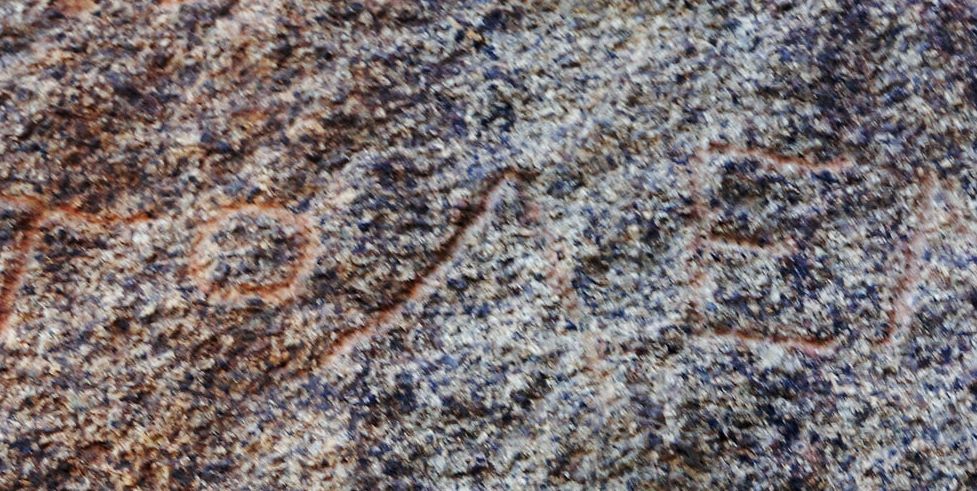
A pharaoh of Egypt came to Mount Gharib! In December of 2013, an Egyptian man, Mr. Hosam Mosa, found a Greek inscription at Jebel Gharib. This discovery was two years after our book Exodus was published.
I was surprised by the inscription for two reasons. First, it was right next to the mountain (less than a hundred feet) on a large boulder situated where Jebel Gharib starts its abrupt and steep climb upward, positioned on the southeast side. Second, it was not a few scratches but a real inscription (31 letters). It was obviously old and he had to point it out to me twice before I began to make out the letters. As will be seen, the pharaoh who had this inscription made would not have stayed long at Mount Gharib. He took what he wanted and left. He did not have the time to make a finished stone with the engraving that he did later, so he used the rough surface of a granite boulder.
If someone thinks such inscriptions are found all over the Egyptian desert, he is mistaken. Over 99 percent of Egyptian inscriptions were found in the Delta and Nile Valley. Wadi Hammamat, about a hundred and fifty miles south of Mount Gharib, has two-hundred inscriptions but outside of that location they are rare and even more rare to find the name of a Pharaoh. Pictures will follow, first from a distance and later close-ups. The first picture will have the area of the inscription highlighted by a white rectangle.
I was surprised by the inscription for two reasons. First, it was right next to the mountain (less than a hundred feet) on a large boulder situated where Jebel Gharib starts its abrupt and steep climb upward, positioned on the southeast side. Second, it was not a few scratches but a real inscription (31 letters). It was obviously old and he had to point it out to me twice before I began to make out the letters. As will be seen, the pharaoh who had this inscription made would not have stayed long at Mount Gharib. He took what he wanted and left. He did not have the time to make a finished stone with the engraving that he did later, so he used the rough surface of a granite boulder.
If someone thinks such inscriptions are found all over the Egyptian desert, he is mistaken. Over 99 percent of Egyptian inscriptions were found in the Delta and Nile Valley. Wadi Hammamat, about a hundred and fifty miles south of Mount Gharib, has two-hundred inscriptions but outside of that location they are rare and even more rare to find the name of a Pharaoh. Pictures will follow, first from a distance and later close-ups. The first picture will have the area of the inscription highlighted by a white rectangle.
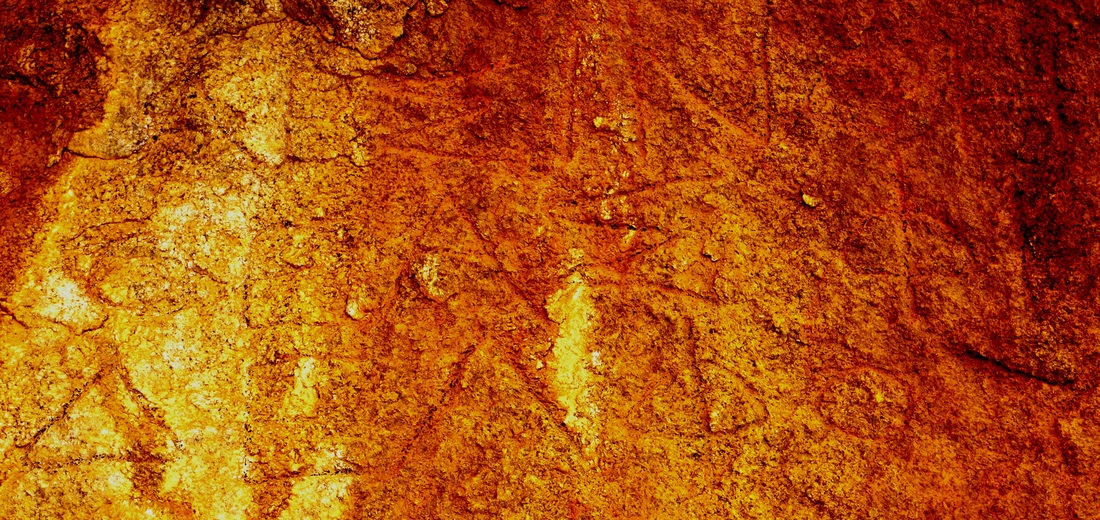
“King Ptolemy Son of Ptolemy” The first line is ΒΑΣΙΛΕΩΣ, “KING”; the second line ΠΤΟΛΕΜΑΙΟΥ, “PTOLEMAIOU”; and the third line reads, ΤΟΥ ΠΤΟΛΕΜΑΙΟΥ, (the) “SON (of) PTOLEMAIOU.” “King Ptolemy Son of Ptolemy” was the title and name of the second king in the Ptolemaic, Greek Dynasty (Ptolemy II also know as Philadelphus. The House of Ptolemy by E. R. Bevan, said, "The young man of twenty-five who became sole king of Egypt in 283 or 282 B.C. is known in history as Ptolemy 'Philadelphus'... He was known to his contemporaries simply as 'Ptolemy the son of Ptolemy.'" (The House of Ptolemy, Chapter III, page 56. http://penelope.uchicago.edu/Thayer/E/Gazetteer/Places/Africa/Egypt/_Texts/BEVHOP/3*.html). Alexander the Great had conquered Egypt in 332 BC, and after his death his kingdom was dived among his four generals, with Ptolemy I Soter taking Egypt.
In May, 2016, was found yet another Greek inscription about 100 feet north of the first inscription. It is by Arsine, the second wife of Ptolemy II. Written in three lines, "Arsinoès theas phila delphou" or "Arsinoe the goddess, the sibling-loving". Ptolemy II married Arsine who was his full sister, something repugnant to even the ancient Greeks, sometime between 280 and 272 BC. http://www.tyndalehouse.com/egypt/ptolemies/arsinoe_ii_fr.htm
In May, 2016, was found yet another Greek inscription about 100 feet north of the first inscription. It is by Arsine, the second wife of Ptolemy II. Written in three lines, "Arsinoès theas phila delphou" or "Arsinoe the goddess, the sibling-loving". Ptolemy II married Arsine who was his full sister, something repugnant to even the ancient Greeks, sometime between 280 and 272 BC. http://www.tyndalehouse.com/egypt/ptolemies/arsinoe_ii_fr.htm
|
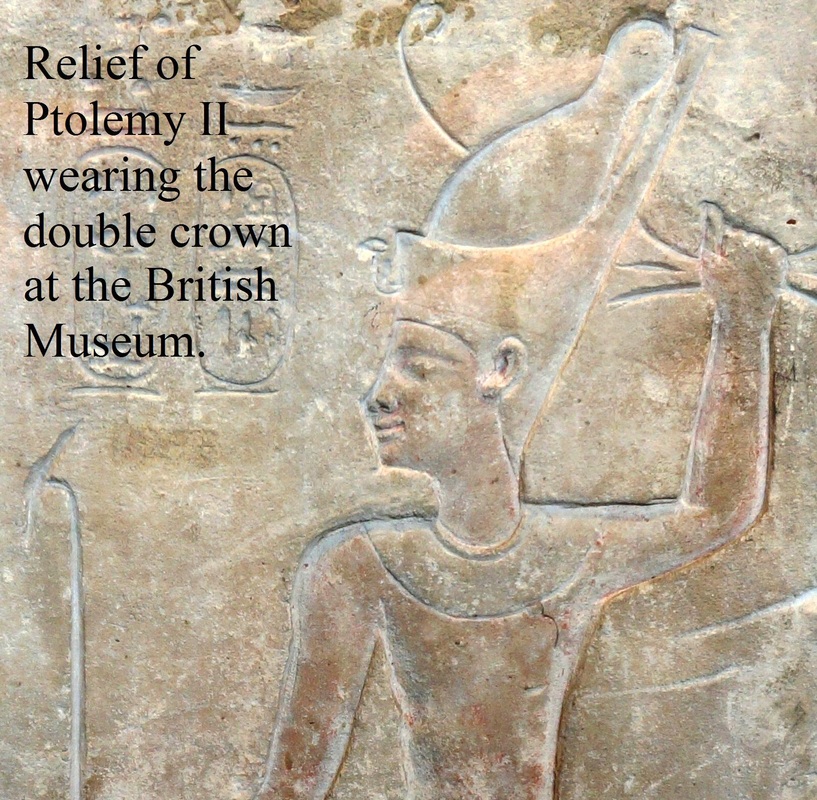
Would you like to help put a puzzle together? What was Ptolemy Philadelphus doing at Mount Gharib? He wanted others to know he was there; he left his title and name engraved in granite. There had to be a reason he went to such an out-of-the-way place.
|
The Quest for Mount Sinai
The third book in our Quest Series and should be read after our Quest for the Red Sea Crossing.
https://www.amazon.com/dp/1982966114
A pharaoh of Egypt went to Mount Sinai and engraved his named there! In December 2013, two years after EXODUS was first published, an inscription made by a pharaoh of Egypt was found at Mount Gharib, which I have proposed as Mount Sinai. And more than a hundred years ago, a hieroglyphic inscription was found in the East Nile Delta, also made by a king of Egypt, describing an expedition to a location the scholars have hotly debated. But the location is now confirmed, for the same king made both inscriptions, and he found something there that only Israel could have left.
What others are saying, Thoroughly Researched, Thoroughly Fascinating
"EXODUS: The Route, Sea Crossing, God's Mountain challenges the old theories about the route by which Moses led the children of Israel out of Egypt. You'll be amused and enlightened as Matheny takes down some of the sacred cows of earlier authors, as effectively as Moses destroyed the golden calf in the wilderness. Wordsmith from GA
Now FREE (and other Christian boooks) on True Christian Short Stories, https://www.truechristianshortstoriesfreebygmmatheny.com/
Both Paperback and Kindle. https://www.amazon.com/dp/1983006815
https://www.amazon.com/dp/B07DBF8TYV
Should we find the twelve pillars that Moses made? Would not the real Mount Sinai have signs of being burnt, and are the Bible scholars right who claim Mount Sinai was an active volcano? Should we find the “sapphire” stones that the seventy elders of Israel saw on Mount Sinai? Was Mount Sinai really the “mountain of God” (Exodus 3:1) or did He have to share it with occult deities? (It is commonly taught that the name Sinai came from a Babylonian moon god, and some of the proposed sites for Mount Sinai were places of worship for pagan gods and covered in pagan symbols.) Would it be wrong to climb this mountain? Why two names for the same mountain (Sinai/Horeb)? Were the eleven days to Kadesh-barnea for Israel or the average person? Why did Elijah need forty days to get to Mount Sinai? Was Mount Sinai the tallest mountain in the area? Could Moses at eighty years of age climb a steep high mountain (Deuteronomy 34:7)? Could Israel have survived in the desert? Where there two Mount Seirs (see our blog)? Where there two locations to the south of Israel named Kadesh (see our blog)? The Scholars say that encampments of such a multitude would have left broken pottery for them to track, but did Israel bring clay pots that are easily broken? What ancient source says she brought metal vessels? Where was the border of southern Israel and the location of Kadesh? How much different where the borders of Egypt, Arabia and the Red Sea in the Days of Moses? Where did Pharaoh live at the time of the Exodus? What is the meaning of Pi-hahiroth? Where in the Bible does it say Israel crossed the Nile River? Did the Midians and the Amalekites live in the Eastern Desert of Egypt? How do we know that the ten plagues that fell on Egypt were supernatural events not natural causes? How did Moses communicate with the multitude that was in the Camp of Israel? Did all ten plagues that fell on Egypt take place within one year or one month? How do we know the 600,000 men of Exodus is to be taken literally? And much more!
The third book in our Quest Series and should be read after our Quest for the Red Sea Crossing.
https://www.amazon.com/dp/1982966114
A pharaoh of Egypt went to Mount Sinai and engraved his named there! In December 2013, two years after EXODUS was first published, an inscription made by a pharaoh of Egypt was found at Mount Gharib, which I have proposed as Mount Sinai. And more than a hundred years ago, a hieroglyphic inscription was found in the East Nile Delta, also made by a king of Egypt, describing an expedition to a location the scholars have hotly debated. But the location is now confirmed, for the same king made both inscriptions, and he found something there that only Israel could have left.
What others are saying, Thoroughly Researched, Thoroughly Fascinating
"EXODUS: The Route, Sea Crossing, God's Mountain challenges the old theories about the route by which Moses led the children of Israel out of Egypt. You'll be amused and enlightened as Matheny takes down some of the sacred cows of earlier authors, as effectively as Moses destroyed the golden calf in the wilderness. Wordsmith from GA
Now FREE (and other Christian boooks) on True Christian Short Stories, https://www.truechristianshortstoriesfreebygmmatheny.com/
Both Paperback and Kindle. https://www.amazon.com/dp/1983006815
https://www.amazon.com/dp/B07DBF8TYV
Should we find the twelve pillars that Moses made? Would not the real Mount Sinai have signs of being burnt, and are the Bible scholars right who claim Mount Sinai was an active volcano? Should we find the “sapphire” stones that the seventy elders of Israel saw on Mount Sinai? Was Mount Sinai really the “mountain of God” (Exodus 3:1) or did He have to share it with occult deities? (It is commonly taught that the name Sinai came from a Babylonian moon god, and some of the proposed sites for Mount Sinai were places of worship for pagan gods and covered in pagan symbols.) Would it be wrong to climb this mountain? Why two names for the same mountain (Sinai/Horeb)? Were the eleven days to Kadesh-barnea for Israel or the average person? Why did Elijah need forty days to get to Mount Sinai? Was Mount Sinai the tallest mountain in the area? Could Moses at eighty years of age climb a steep high mountain (Deuteronomy 34:7)? Could Israel have survived in the desert? Where there two Mount Seirs (see our blog)? Where there two locations to the south of Israel named Kadesh (see our blog)? The Scholars say that encampments of such a multitude would have left broken pottery for them to track, but did Israel bring clay pots that are easily broken? What ancient source says she brought metal vessels? Where was the border of southern Israel and the location of Kadesh? How much different where the borders of Egypt, Arabia and the Red Sea in the Days of Moses? Where did Pharaoh live at the time of the Exodus? What is the meaning of Pi-hahiroth? Where in the Bible does it say Israel crossed the Nile River? Did the Midians and the Amalekites live in the Eastern Desert of Egypt? How do we know that the ten plagues that fell on Egypt were supernatural events not natural causes? How did Moses communicate with the multitude that was in the Camp of Israel? Did all ten plagues that fell on Egypt take place within one year or one month? How do we know the 600,000 men of Exodus is to be taken literally? And much more!
Our main site is
TRUE CHRISTIAN SHORT STORIES BY G. M. MATHENY - Home
FREE eBooks, short stores, helpful videos and more!
https://www.truechristianshortstoriesfreebygmmatheny.com/
PODCASTS
Hi everyone! We have uplifting and encouraging stories for you! Everything from top secret submarine espionage, to bringing our six small children on a train from Portugal to Romania, where we served as missionaries for 30 years. I believe you will enjoy, learn, and hopefully be helped by our life experiences.
The following platforms have our podcast.
1. SPOTIFY, https://open.spotify.com/show/1iTDIZhH9hMEZvVr8jrpqQ
2. PLAYER FM, https://player.fm/series/true-christian-stories-by-garry-nancy-matheny
3. STITCHER, https://www.stitcher.com/show/true-christian-stories-by-garry-nancy-matheny
4. Podcast Index, https://podcastindex.org/podcast/4393008
5. iHeartRadio, https://www.iheart.com/podcast/269-true-christian-stories-by-88074086/
6. Deezer, https://www.deezer.com/us/show/3071332
7. Podcast Addict, https://www.podcastaddict.com/podcast/3666665
8. Podchaser, https://www.podchaser.com/podcasts/true-christian-stories-by-garr-198868810.
9. Audible, https://www.audible.com/pd/Podcast/B08K568Z3G
10. Amazon Music, https://music.amazon.com/podcasts/40976882-993c-47a4-86e5-18bf3240362f/true-christian-stories-by-garry-nancy-matheny
A Few of Our Podcast Titles.
“Aliens” in Revelation, Part 1,
Lord, get us to Romania,
James 4:2 "ye have not, because ye ask not"
Inspiration of Scriptures
The Tree of Marriage
Excuses of Moses
TRUE CHRISTIAN SHORT STORIES BY G. M. MATHENY - Home
FREE eBooks, short stores, helpful videos and more!
https://www.truechristianshortstoriesfreebygmmatheny.com/
PODCASTS
Hi everyone! We have uplifting and encouraging stories for you! Everything from top secret submarine espionage, to bringing our six small children on a train from Portugal to Romania, where we served as missionaries for 30 years. I believe you will enjoy, learn, and hopefully be helped by our life experiences.
The following platforms have our podcast.
1. SPOTIFY, https://open.spotify.com/show/1iTDIZhH9hMEZvVr8jrpqQ
2. PLAYER FM, https://player.fm/series/true-christian-stories-by-garry-nancy-matheny
3. STITCHER, https://www.stitcher.com/show/true-christian-stories-by-garry-nancy-matheny
4. Podcast Index, https://podcastindex.org/podcast/4393008
5. iHeartRadio, https://www.iheart.com/podcast/269-true-christian-stories-by-88074086/
6. Deezer, https://www.deezer.com/us/show/3071332
7. Podcast Addict, https://www.podcastaddict.com/podcast/3666665
8. Podchaser, https://www.podchaser.com/podcasts/true-christian-stories-by-garr-198868810.
9. Audible, https://www.audible.com/pd/Podcast/B08K568Z3G
10. Amazon Music, https://music.amazon.com/podcasts/40976882-993c-47a4-86e5-18bf3240362f/true-christian-stories-by-garry-nancy-matheny
A Few of Our Podcast Titles.
“Aliens” in Revelation, Part 1,
Lord, get us to Romania,
James 4:2 "ye have not, because ye ask not"
Inspiration of Scriptures
The Tree of Marriage
Excuses of Moses
The book GOD & SPIES
GM Matheny was a US Navy saturation diver on the nuclear submarine USS Halibut. Involved in "Operation Ivy Bells". America’s most important and most dangerous of the Cold War clandestine operations. If you like good old fashioned American bravado, espionage and American history, you will enjoy this book.
Based on True Events -The Mount Everest of Spy Missions
Firsthand account of history's greatest intelligence coup. Operation Ivy Bells was not a onetime intercept of foreign intelligence, but an ongoing operation of multiple Soviet military channels, twenty-four hours a day, seven days a week, which lasted for years! Another reason for the high interest in our operation was the audacious nature in which it was done—with not one person risking his neck but a whole crew of a nuclear submarine.
How did I end up as a navy diver, four hundred feet down in a frigid Russian sea? After making my dad totally disgusted with me, I set out to make him happy. “Honour thy father” - I struggled with a decision to serve God. “Lord, I will give my life to you and serve you if you let me make this dive.” But I had the impression He only wanted to know one thing: “What if I do not let you? Will you serve me anyway?”
Now FREE (and other Christian boooks) on True Christian Short Stories, https://www.truechristianshortstoriesfreebygmmatheny.com/
Paperback 250 pages, $7.97 https://www.amazon.com/dp/1075452430
Kindle $3.14! https://www.amazon.com/dp/B07TCSLFWR
GM Matheny was a US Navy saturation diver on the nuclear submarine USS Halibut. Involved in "Operation Ivy Bells". America’s most important and most dangerous of the Cold War clandestine operations. If you like good old fashioned American bravado, espionage and American history, you will enjoy this book.
Based on True Events -The Mount Everest of Spy Missions
Firsthand account of history's greatest intelligence coup. Operation Ivy Bells was not a onetime intercept of foreign intelligence, but an ongoing operation of multiple Soviet military channels, twenty-four hours a day, seven days a week, which lasted for years! Another reason for the high interest in our operation was the audacious nature in which it was done—with not one person risking his neck but a whole crew of a nuclear submarine.
How did I end up as a navy diver, four hundred feet down in a frigid Russian sea? After making my dad totally disgusted with me, I set out to make him happy. “Honour thy father” - I struggled with a decision to serve God. “Lord, I will give my life to you and serve you if you let me make this dive.” But I had the impression He only wanted to know one thing: “What if I do not let you? Will you serve me anyway?”
Now FREE (and other Christian boooks) on True Christian Short Stories, https://www.truechristianshortstoriesfreebygmmatheny.com/
Paperback 250 pages, $7.97 https://www.amazon.com/dp/1075452430
Kindle $3.14! https://www.amazon.com/dp/B07TCSLFWR